Buy Dry Ice Plastic containers

Plastic Dry Ice Cooler Boxes for Sale

Cryo Bin 360 Litre:

These plastic ice containers are heavy duty Cooler Boxes designed for maximum insulation with the aid of double walls and Polyurethane foam and made from UV Stabilised 100% recyclable material.

Outer Dimensions L 1190 x W 780 x H 935 mm
Inner Dimensions L 1040 x W 625 x H 585 mm

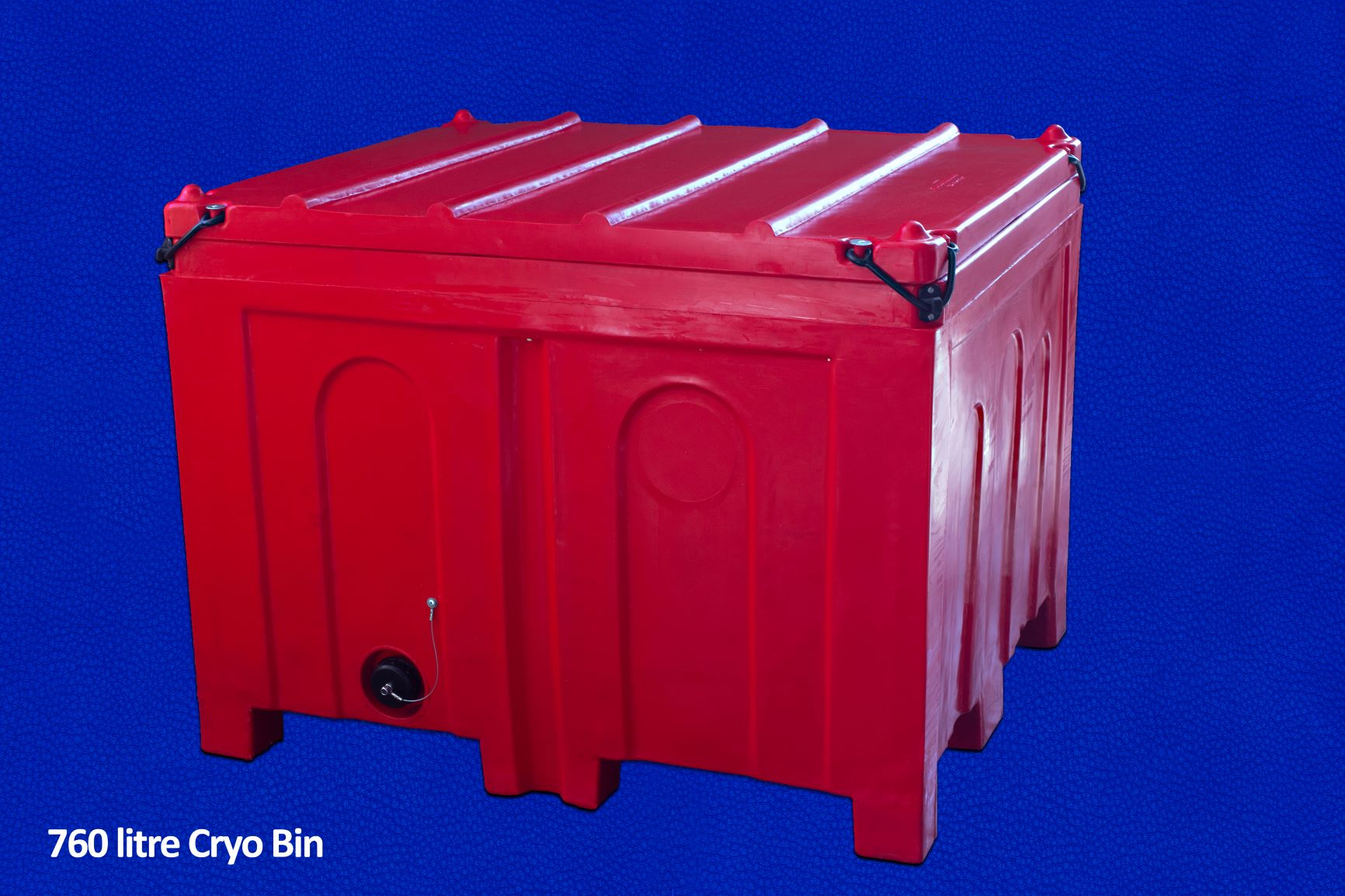
Cryo Bin 760 Litre:

These plastic ice containers are heavy duty Cooler Boxes designed for maximum insulation with the aid of double walls and Polyurethane foam and made from UV Stabilised 100% recyclable material.

Outer Dimensions L 1200 x W 1235 x H 915 mm
Inner Dimensions L 1135 x W 915 x H 695 mm

Plastic Dry Ice Storage Containers in Southern Africa

Protect your dry ice investment with purpose-built plastic storage solutions. Dry Ice Africa supplies durable, insulated plastic containers (HDPE, double-wall, foam-filled) engineered for dry ice transport and storage across Africa’s varied climates.

Why Use Plastic Containers for Dry Ice Storage?

  • Minimise sublimation losses: High-quality plastic containers slow heat ingress and reduce sublimation. Foam-filled insulation provides superior thermal protection.
  • Robust and reusable: HDPE or UV-stabilised polyethylene shells resist impact, chemicals, and moisture, ideal for repeated industrial or food-grade use.
  • Safe venting & pressure control: Containers allow CO gas to escape safely—airtight designs risk pressure build-up.
  • Scalable formats: From compact carry-cases to bulk bins (70 L+ capacity), containers suit blocks, pellets, or slabs of dry ice.

These benefits are vital under Southern Africa’s heat, humidity, and logistical challenges.

Container Technology & Specifications

All containers meet food-safety and cold-chain standards. They are easy to clean, sanitize, and reuse in hygienic operations.

Best Practices for Using Plastic Dry Ice Containers

  1. Pre-chill: Lower container temperature before loading dry ice.
  2. Pack correctly: Place dry ice above cargo, fill gaps with insulating material, and limit air pockets.
  3. Never seal airtight: Ensure a vent path to release CO gas safely.
  4. Monitor load level: Keep containers fuller for slower sublimation. Refill from a master container when possible.
  5. Manage heat exposure: Avoid sunlight and extreme heat (>35°C). Use shade or reflective covers outdoors.
  6. Maintain containers: Inspect seals, hinges, and gaskets; replace worn parts and clean with food-safe products.

Applications in Africa and Southern Africa

  • Food & fisheries: Transport seafood from coastal landings (e.g., KZN, Mozambique) inland with extended freshness.
  • Pharmaceutical logistics: Preserve vaccine stability across rural provinces where reliable cold chain is critical.
  • Events & catering: Store pellets for safe fog effects at weddings, concerts, or sports events.
  • Industrial & laboratories: Maintain leftover dry ice for blasting or research samples.

Our containers also comply with WHO / NICD packaging instructions P620/P650 for infectious substances shipped with dry ice.

Legal & Compliance Context (South Africa)

  • Food safety & hygiene standards: Containers comply with national food safety and hygiene regulations.
  • Hazardous goods & transport laws: Dry ice (UN 1845) is regulated—our containers meet venting and packaging guidelines.
  • B-BBEE & procurement: We support local manufacturing and economic empowerment policies.

Why Choose Dry Ice Africa’s Containers?

  • Pan-African support: Serving Southern Africa with reliable logistics and service.
  • Integrated solutions: Containers tailored to match your dry ice volume and usage.
  • Technical expertise: Training and guidance on safety, venting, and compliance.
  • Safety culture: Strict adherence to SDS, SABS standards, and national regulations.

Call to Action

Secure your dry ice container solution today. Contact us for quotes, technical support, or a site visit:
031 569 6209 | Emergency: 083 375 6627
info@dryice.co.za
Visit: Unit 32, 10 Moreland Dr, Red Hill, Durban North

There are numerous names for cooler boxes, including a portable ice chest, a cooler, an ice box, a cool box, a chilly bin in New Zealand, and an esky in Australia. All of these terms are used to describe a box that is insulated and intended to store food or drink at a cold temperature. We also offer dry ice Cape Town.


Picnics, road trips, and family holidays aren’t complete without a cooler. In places where summers are particularly hot, they can be used just for the purpose of transporting cold food from the shop to the home. For example, ice cream would not melt as quickly in the car. 


Dry Ice Africa is a prominent dry ice provider and producer located in Gauteng, South Africa. We produce a wide variety of dry ice products, including dry ice blocksdry ice pelletspolystyrene ice boxes, and cooler boxes for sale.


We are situated in a convenient location in Spartan on the East Rand; the OR Tambo International Airport can be reached by car in only 10 minutes, and the city centre of Johannesburg can be reached in just 20 minutes. All of the neighbouring districts of Johannesburg are serviced by a sizable fleet of delivery vehicles. Dry ice can be purchased straight from the manufacturing plant, where it is also possible for members of the public to see the production facility.


Insulation and ice in portable coolers work like magic to keep contents chilly. The insulation, typically formed of plastic, coats the interior of your cooler, reducing the speed at which warm air can escape. Meanwhile, the ice will keep everything chilled inside your cooler.


Both convection and conduction allow heat energy to spread and melt ice chunks. While convection is air flow, conduction is heat moving directly through ice cooler walls. By closing the cooler’s lid, you prevent warm air from circulating and melting the ice, thus convection plays less of a role. However, more ice melting occurs when heat energy is transferred through the cooler’s walls. Therefore, it is strongly suggested that the cooler not be placed in direct sunlight. Cooling still occurs even if the cooler is placed in the shade, however at a slower rate.


Whether or not to invest in a cooler box is a decision that should be made on a case-by-case basis, with consideration given to both price and safety issues. We tend to believe that the most expensive option is the best, but you still need to think about your preferred method of camping and the layout of your pitch.


Our Cryo Bin cooler boxes are heavy-duty containers that have been developed for optimal insulation with the assistance of double walls and polyurethane foam. Additionally, these boxes are made from UV-stabilized material that is 100 percent recyclable.


If you go camping on a frequent basis, you should choose a cool box that is of high quality and will endure for several years. The quality of a cool box will be determined by the season you camp in and the temperature of the environment outside. When used in high outside temperatures, a cooler that is less expensive and provides less insulation will require a continual rotation of ice bags or freeze blocks. In addition, the capacity of the cool box will be determined by the total number of holidaymakers as well as the timeframe of the trip.


Cool boxes are typically described in terms of the number of litres they can hold, rather than the number of people who will be using them. A standard 18-liter cooler can hold about 25 to 28 cans, while a 30-liter cooler can hold about 50, and anything larger than this can hold a wide variety of food and drink containers.


Most coolers require ice to maintain a cold temperature, in addition to the insulation they already have. Whether you use cube ice, dry ice, or a block of ice, the ice in your cooler will stay frozen for at least a few days, and sometimes much longer. While it may come as a surprise, dry ice can be utilised inside of your cooler. For your next camping trip, gently wrap it in several layers of newspaper and layer it between your food. Warning: dry ice is extremely harmful if left in a vehicle for long periods of time or if handled with bare hands. Exercise caution when working with dry ice.


You can keep both the cooler and the ice colder by tending to a few basics. Close the container as quickly as you can. If the cooler lid is propped open, warm air will enter faster. Locate a great shady area to store your cooler, if you can. Fill  whatever surplus space you have with frozen water bottles. These will not only act as additional ice packs, but they will also prevent warm air from entering the cooler.

FAQ's

With proper insulation, expect 5–10% loss per 24 hours.

Possible, but performance is inferior due to thinner insulation.

Yes. They are made from food-grade HDPE and are sanitisable.

Yes, never seal airtight. Venting prevents dangerous pressure build-up.

In 30°C+ conditions, expect faster losses – plan conservatively.

Yes, designed to meet UN 1845 and P620/P650 guidelines.

 Inspect seals and hinges, clean with mild detergents, and replace worn parts.

Dry ICE Africa

Gauteng

0113948642

Western Cape

+27605753739